
The short answer
Most people are ready for a definitive, long-term prosthetic leg somewhere between two and six months after amputation, once the surgical wound has fully healed, swelling has settled and the residual limb (the "stump") has stabilised in shape and volume. Many patients are walking in a temporary or interim prosthesis well before that, sometimes within two to three weeks of surgery, but the exact fitting date always depends on how an individual limb heals rather than on a fixed calendar. In South Africa, the timeline you actually experience also depends heavily on which part of the healthcare system you're in, which we unpack below.
Why you can't be fitted on day one
Straight after amputation, the residual limb is swollen and the incision is still healing, so its shape and volume keep changing for weeks. A socket built for a swollen limb becomes loose within a short time, so a prosthetist deliberately waits for the limb to settle before casting or scanning for a device meant to last. Cleveland Clinic notes it typically takes two to three months for the surgical wound to heal and swelling to reduce enough for prosthetic fitting to begin, and the Merck Manual explains that a permanent prosthesis is usually only made once the residual limb has had time to shrink completely.
During this early phase, rehabilitation is already under way even though there's no prosthesis yet. Positioning exercises, gentle strengthening and mobility training with crutches, a walker or a wheelchair start within days of surgery to prevent stiffness and maintain overall fitness for when walking training begins in earnest.
Shrinkers, compression and shaping the limb
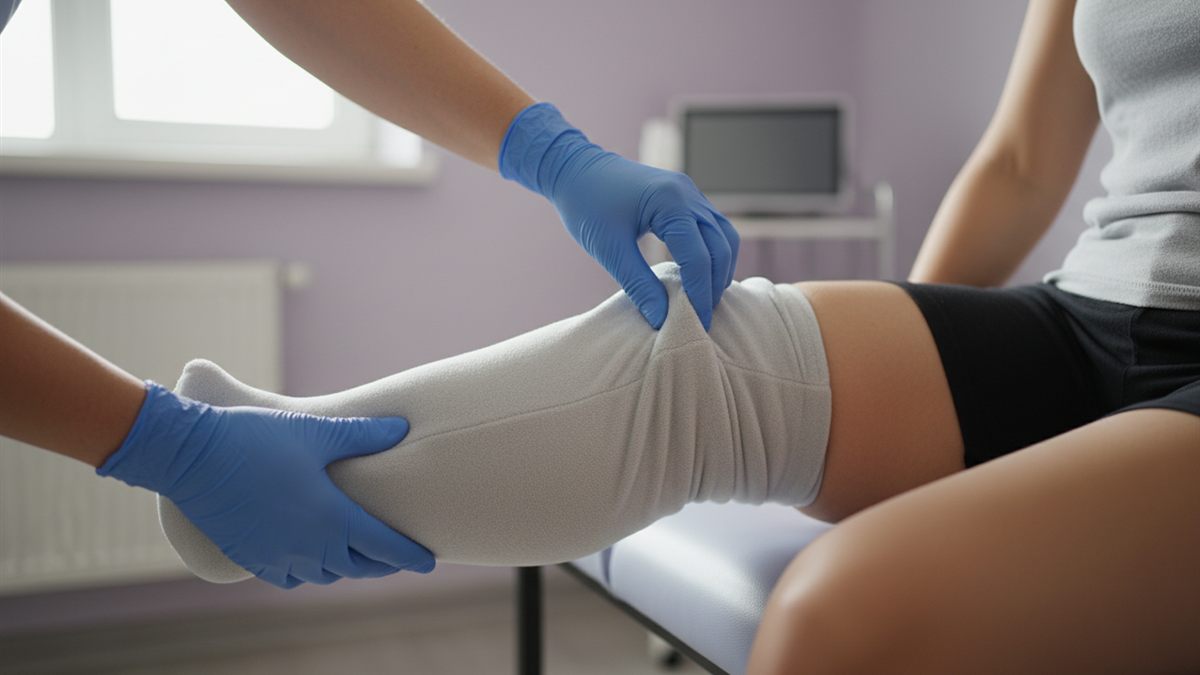
Shrinking and shaping the residual limb is one of the most important, and most controllable, parts of this waiting period. A compression shrinker sock or, in some cases, rigid or semi-rigid removable dressings, are worn for most of the day to reduce swelling, encourage a consistent, tapered shape and protect the limb from knocks. The Merck Manual lists elastic shrinkers, compression bandaging and the prosthesis's own gel liner among the standard ways to manage residual-limb swelling between fittings, and consistent, prosthetist-approved compression wear is one of the few things a new amputee can actively do to help keep the timeline moving. If your surgeon or prosthetist advises graduated compression garments as part of your recovery, our compression service covers professionally fitted options alongside your prosthetic care.
Because the limb keeps changing shape for months, not weeks, this is also why an interim device rather than the final prosthesis usually comes first.
Interim (preparatory) prosthesis vs the definitive limb
Many prosthetists fit an interim, or "preparatory", prosthesis before the definitive one. This is a fully functional device, often built with a simpler or adjustable socket, that lets you start standing, weight-bearing and gait training while the limb is still shrinking. The Amputee Coalition notes that some patients receive a temporary prosthesis within two to three weeks of surgery. Earlier weight-bearing like this can also help the limb settle into a more even shape sooner, though every patient's timeline still depends on their own healing.
The definitive (permanent) prosthesis is only cast, built and fitted once volume and shape have stabilised, commonly in the two-to-six-month window after surgery, though this varies with wound healing, amputation level, vascular status, and general health. Even after the definitive limb is delivered, expect several follow-up visits in the first year for socket adjustments as the limb continues to mature. Our prosthetics service includes this full pathway, from early interim fitting through to definitive socket refinement, with home or hospital visits available where travel is difficult.
South Africa: public sector reality vs the private route
This is where the South African context matters a great deal. Public-sector prosthetic services face well-documented capacity constraints: a 2025 African Journal of Disability study on health system barriers to prosthetic service delivery cites figures as low as 8% for the proportion of South African amputees who are ever fitted with a prosthesis, and describes waiting times reported by users as running to months and, in some cases, years for a first fitting appointment. The same research links this to under-filled clinical posts, supply chain and procurement delays, and rural transport and distance barriers that keep people from reaching the few dedicated centres that exist.
By contrast, a peer-reviewed study on South Africa's private prosthetic sector describes a funding landscape built around the Council for Medical Schemes' Prescribed Minimum Benefits (PMB), the Road Accident Fund, and workplace compensation (COIDA/WCA). Each of these routes has its own paperwork and authorisation steps, but, as the funding timelines below show, they generally involve turnaround measured in weeks to months rather than the multi-year public-sector waits described above. Practically, this means the private route is usually the more predictable pathway for people who need an approximate fitting date, which is why understanding your funding option early is worth doing at the same time as your first prosthetist consultation.
If you have medical scheme cover, a prosthetic limb often falls under PMB or a scheme-specific prosthetic benefit; Össur South Africa's guidance on financial considerations notes that PMB-related funding decisions commonly take around 60 days to be confirmed, while COIDA/WCA claims can take several months to be answered. Road Accident Fund claims follow their own separate legal and administrative process and are generally the slowest of the three to resolve, so it's worth asking your prosthetist or case manager which funding route applies to you as early as possible. Because component choice, socket complexity and any additional orthotic needs all affect the final cost, it's best to ask your prosthetist for a written, itemised quotation early, so you and your medical scheme (or other funder) know exactly what's being requested and why.
What you can do while you wait
Keep wearing your shrinker or compression garment as instructed, even when it's uncomfortable, since consistency is what shapes the limb evenly. Attend physiotherapy and mobility sessions rather than waiting for the prosthesis to "start rehab". The strength, balance and range of motion you build now can affect how well the definitive limb performs later. Keep the wound and skin of the residual limb clean and report any redness, drainage or new pain promptly, since skin problems can delay casting. If a custom orthosis is needed for the other limb or for related joint support during this period, our custom orthotics and off-the-shelf orthotics services can assist, and our conditions page has further background on related musculoskeletal issues that sometimes accompany limb loss.
When to see a prosthetist
If you've had a recent amputation, book a prosthetist assessment as soon as your surgeon or ward team gives the go-ahead. The sooner shrinker use and pre-prosthetic exercises start, the smoother the path to a definitive limb tends to be. If it's been longer than six months without a fitting, or you're unsure which funding route applies to you, an assessment can clarify realistic timelines for your specific situation. This article is general information for South African patients and does not replace individual clinical advice from your surgeon, GP or HPCSA-registered prosthetist; every residual limb heals differently. To discuss your situation, including home or hospital visits in and around Centurion, book an assessment.
Key takeaways
- A definitive prosthetic leg is usually fitted 2–6 months after amputation, once wound healing, swelling and limb shape have stabilised.
- An interim (preparatory) prosthesis, sometimes fitted within 2–3 weeks of surgery, lets you start standing and walking earlier while the limb continues to shrink.
- Consistent shrinker/compression wear and early physiotherapy are the main things a patient can actively do to keep the timeline on track.
- South Africa's public prosthetic services face major capacity constraints. One 2025 study cites figures as low as 8% of amputees ever being fitted, with waiting times reported from months to several years.
- The private route, funded via medical scheme PMBs, the Road Accident Fund or COIDA, is generally the more predictable timeline for most patients. Get a written quotation and confirm funding early.
Have a question about your own situation?
Every device we provide starts with an individual assessment: at home, in hospital, or at the practice.
References
- Amputation: What It Is, Types, Risks & Recovery (Cleveland Clinic)
- Rehabilitation After Limb Amputation (Merck Manual (Consumer Version))
- Residual Limb Swelling (Merck Manual (Consumer Version))
- Prosthetic FAQs for the New Amputee (Amputee Coalition)
- Health systems solutions to prosthetic service delivery obstacles in a low-resource setting (African Journal of Disability (AOSIS))
- Exploring the need for lower limb prosthetic guidelines in South Africa's private healthcare sector (Canadian Prosthetics & Orthotics Journal)
- Financial Considerations for Prosthetics (Össur South Africa)